Medical protective products are designed to create a dependable barrier between people and biological, chemical, or physical hazards. Their performance depends heavily on material selection. A disposable gown must resist fluid splashes, while a respirator needs controlled filtration and a secure seal. Gloves must balance protection with touch sensitivity. Small design choices matter.
So, what materials are used in medical protective products? Common options include polypropylene, polyethylene, polyurethane, nitrile, latex, polyester, and specialized multilayer laminates. Each material offers different strengths. Polypropylene is lightweight and widely used in nonwoven gowns and caps. Nitrile provides useful puncture resistance for many examination gloves. Polyethylene can improve liquid resistance, although it may feel less breathable. Some products combine several layers, creating a more practical balance between comfort, barrier performance, and durability.
Real-world use reveals an important limitation. No single material performs perfectly in every clinical setting. A thick barrier may protect well but restrict movement and increase heat buildup. A softer material may feel comfortable but tear more easily under stress. Therefore, selecting medical protective materials requires testing, documented specifications, and attention to the intended exposure. Manufacturers should evaluate filtration, tensile strength, seam integrity, skin contact, and breathability. Healthcare workers should also consider fit, storage conditions, and correct disposal practices. This guide examines seven widely used materials and explains where each one performs well, where it may fall short, and why informed selection supports safer medical work.
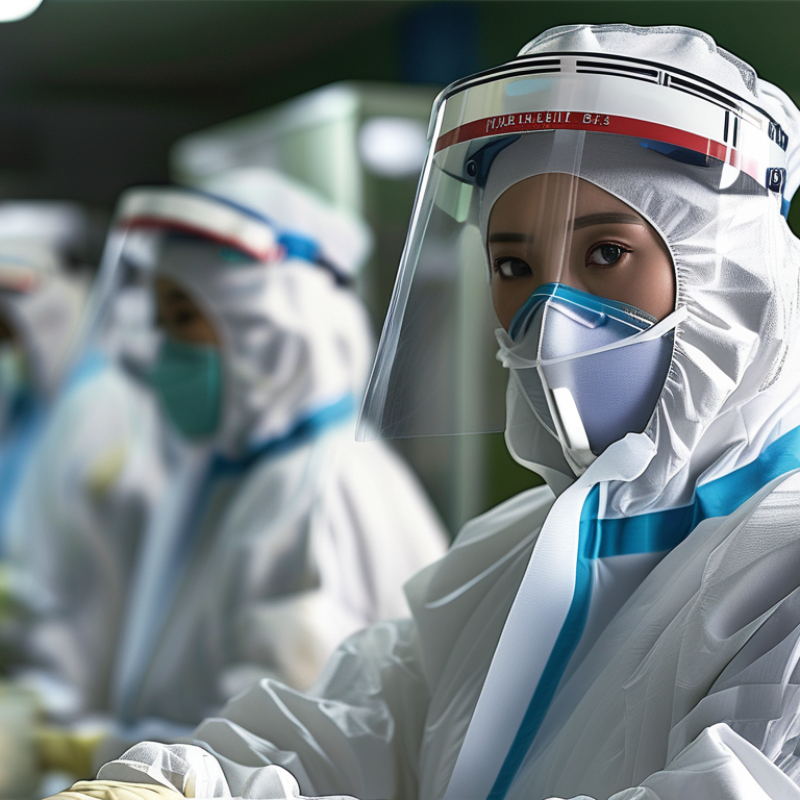
Medical protective products need more than a soft, white surface. Seven useful material families include spunbond polypropylene, meltblown polypropylene, polyethylene film, polyurethane, polytetrafluoroethylene laminates, polyester, and medical-grade silicone. Each solves a different problem. Spunbond polypropylene provides structure and breathability. Meltblown layers improve particle filtration. Polyethylene film blocks liquid splashes, while polyurethane supports flexible, close-fitting seals.
Standards should guide material selection, not marketing language. EN 14126 evaluates resistance to infected liquid, aerosols, and contaminated particles. ISO 16603 uses synthetic blood to screen resistance under pressure. ISO 16604 adds bacteriophage penetration testing, which better represents a virus-sized challenge. Passing ISO 16603 alone does not prove viral protection. That distinction is often missed.
WHO’s Global Report on Infection Prevention and Control (2022) estimates that healthcare-associated infections affect about 7% of patients in high-income countries and 15% in low- and middle-income countries. Material failures can worsen exposure, but poor donning, seam leakage, and incorrect sizing also matter. A high hydrostatic-pressure result may reduce comfort and increase heat stress. That is a real trade-off. In practice, compare test pressure, seam construction, breathability, and intended exposure together. Product data should state the test method, class, conditioning, and limitations clearly. Some “best material” claims remain too broad, especially when they ignore movement, repeated contact, or wet conditions.
Disposable medical protective products often use polypropylene and polyethylene in a three-layer barrier. Polypropylene, or PP, usually forms the soft outer and inner nonwoven layers. It feels light, allows some air movement, and supports comfortable wear during long procedures. The middle layer may contain fine meltblown PP fibers. These fibers help reduce the passage of particles when the material is properly manufactured.
Polyethylene, or PE, adds a different function. A thin PE film can improve resistance to splashes and liquid contact. In some designs, PE is laminated to PP rather than used as a separate fabric. This combination can create a practical balance between protection, flexibility, and cost. However, a three-layer structure is not automatically safer. Seams, elastic edges, poor fit, and damaged packaging can weaken the barrier. In practical evaluations, I would check the fabric, joining points, and surface condition together. Material performance also depends on testing, storage, and intended use.
Tips: Hold the fabric near a bright light. Uneven areas may suggest inconsistent bonding or thickness. Check whether the PE layer feels continuous, not cracked or brittle. Do not judge comfort by softness alone. A very smooth surface may reduce airflow. This is an easy detail to overlook. Always compare product claims with documented test results and handling instructions.
Representative melting ranges help explain why polypropylene and polyethylene are widely selected for disposable medical protective products. Polypropylene is commonly used in spunbond and meltblown nonwoven layers, while polyethylene is often used in liquid-resistant films and coatings.
The ranges are representative polymer melting ranges in degrees Celsius. Actual values vary according to polymer grade, crystallinity, additives, and processing conditions. ASTM D3418 is commonly used to determine polymer melting transitions by differential scanning calorimetry.
In medical protective products, the barrier film often decides comfort and reliability. PVC and EVA remain useful because they offer flexibility, heat-sealing performance, and clear visual inspection. EVA contains vinyl acetate, which improves softness at folds and cuffs. PVC can provide consistent film thickness when plasticizer migration is controlled. The formulation still matters.
At 13.8 kPa, or 2 psi, a flexible film faces a serious fluid-pressure challenge. ASTM F1671/F1671M uses bacteriophage penetration testing for materials used in protective clothing. Its test data should identify pressure, exposure time, seams, and the exact specimen structure. ISO 16603 also measures resistance to synthetic blood penetration across graded pressures. These results are valuable, but they do not prove protection against every fluid or pathogen.
In practical testing, a pinhole near a welded seam can matter more than a smooth central panel. EVA may bend repeatedly without immediate cracking, while PVC performance can change with temperature and aging. The Hohenstein Textile Testing Institute notes that protective clothing performance depends on material, garment design, and manufacturing quality. I would not treat 13.8 kPa as a magic number. It is one checkpoint. A stronger evaluation combines pressure testing, seam inspection, aging tests, and repeated flexing under realistic use conditions.
| Material | Common Protective Product Form | Typical Thickness or Basis Weight | Typical Tensile Strength | Typical Elongation at Break | Key Barrier and Flexibility Characteristics | 13.8 kPa Hydrostatic Pressure Screening | Typical Limitations |
|---|---|---|---|---|---|---|---|
| Flexible PVC | Transparent tubing, examination-apron film, fluid-resistant covers and bags | 0.20–0.80 mm film | 10–25 MPa | 200–450% | Very flexible, weldable and naturally resistant to water-based fluids. Transparent grades support visual inspection. | Suitable for a 13.8 kPa film screening when seams and welds are properly formed. Actual pass/fail performance must be measured on the finished product. | Plasticizer selection affects flexibility and extractables. Chlorine-containing material requires controlled disposal or recycling practices. |
| EVA | Flexible protective film, cushioning layers, shoe covers and fluid-resistant liners | 0.10–0.50 mm film | 10–25 MPa | 300–800% | Soft, flexible and heat-sealable. Ethylene-vinyl acetate is commonly selected when low-temperature flexibility and low moisture absorption are needed. | Suitable for evaluation at 13.8 kPa, particularly in continuous films. Film gauge, vinyl-acetate content, punctures and seams determine the result. | Lower stiffness and load-bearing strength than many rigid plastics; elevated temperature can increase deformation. |
| Polyethylene (PE) | Disposable gowns, aprons, sleeve covers, shoe covers and impermeable film | 0.02–0.15 mm film | 15–35 MPa | 200–600% | Low water absorption, good chemical resistance and low cost. High-density PE provides more stiffness; low-density PE provides greater softness. | Often appropriate for 13.8 kPa barrier screening when the film is continuous and defect-free. Thin film and seam integrity are critical. | Low surface energy can make printing, coating and some bonding processes difficult without surface treatment. |
| Thermoplastic Polyurethane (TPU) | High-performance medical film, tubing, wound-contact covers and flexible seals | 0.05–0.50 mm film | 25–50 MPa | 400–700% | Excellent elasticity, abrasion resistance and tear resistance. Can provide a strong balance between flexibility and mechanical durability. | Generally well suited to 13.8 kPa testing. The final result depends on hardness, film thickness, formulation and welded-joint quality. | Some grades are sensitive to hydrolysis, heat or selected disinfectants; grade-specific compatibility testing is required. |
| Silicone Rubber | Face seals, gaskets, respiratory interfaces, tubing and reusable protective components | 0.50–3.00 mm molded or extruded section | 5–12 MPa | 200–700% | Highly flexible across a broad temperature range and generally resistant to aging, ozone and moisture. Suitable for repeated-use sealing components. | Can be evaluated at 13.8 kPa for seal and leak performance. Pressure retention depends more on geometry, compression and joint design than on tensile strength alone. | Lower tear strength than TPU in many formulations; silicone surfaces can attract dust and may be difficult to bond. |
| Polypropylene (PP) Nonwoven | Disposable isolation gowns, caps, masks and spunbond/meltblown protective layers | 20–60 g/m² for common nonwoven layers | Usually reported by fabric direction and basis weight rather than film MPa values | Typically 30–100%, depending on web structure and orientation | Lightweight, low moisture absorption and economical. Multilayer SMS structures improve particulate and splash resistance. | A single spunbond layer is not automatically equivalent to a 13.8 kPa liquid barrier. Test the complete laminate, seams and garment construction. | Porous structures require appropriate layering or coating for liquid resistance; puncture and seam performance can vary substantially. |
| Nitrile Rubber | Examination gloves, chemical-resistant gloves and flexible protective seals | 0.05–0.20 mm glove film | 14–30 MPa | 400–700% | Good resistance to many oils, fuels and chemicals, with strong puncture and tear performance in properly formulated gloves. | Suitable for liquid-leak and integrity evaluation near 13.8 kPa when tested as a finished glove or component. Material pressure performance cannot be inferred from tensile data alone. | Limited resistance to some ketones, strong oxidizers and certain solvents; formulation and thickness strongly affect protection. |
Nitrile, neoprene, and natural rubber each serve different roles in medical protective products. Among them, nitrile receives specific attention under ASTM D6319, which covers nitrile rubber examination gloves. The standard addresses dimensions, physical strength, aging performance, and freedom from holes. These checks matter when gloves face stretching, moisture, and repeated hand movement.
ASTM D6319 helps buyers compare consistent product performance. However, compliance does not guarantee perfect protection for every procedure. Glove thickness, cuff length, texture, and fit still affect practical use. Nitrile offers strong resistance to many common chemicals and avoids natural rubber latex proteins. Neoprene can provide flexibility and chemical resistance, while natural rubber often delivers excellent elasticity and tactile sensitivity. Yet natural rubber may concern users with latex allergies. Material selection should match the task, exposure, and wearer.
Tips: Check the product documentation for ASTM D6319 claims and lot information. Inspect gloves under bright light before use. A small tear matters. Confirm the size by testing finger movement, not only palm width. Replace gloves after contamination or visible damage. Do not assume a thicker glove always performs better; thickness can reduce dexterity and increase hand fatigue. In real workplaces, rushed donning sometimes causes unnoticed stretching. That weakness deserves review. Staff training, storage conditions, and correct disposal also influence protection, although ASTM D6319 cannot measure every workplace variable.
Seven materials are common in medical protective products: spunbond polypropylene, meltblown polypropylene, polyethylene film, microporous laminate, polyurethane, polyvinyl chloride, and expanded PTFE.
Spunbond polypropylene is light and breathable, but its tear strength can be modest.
Meltblown polypropylene improves filtration, though it may need support layers.
Polyethylene film blocks liquid effectively, yet its MVTR is often low.
Microporous laminates balance moisture vapor transmission and liquid resistance. Their pores can clog with contamination or pressure.
Polyurethane usually offers flexible protection and moderate MVTR.
Polyvinyl chloride resists fluids well, but feels less breathable.
Expanded PTFE provides high MVTR in suitable constructions, but its cost and seam design require attention.
Tear strength should be checked in both machine and cross directions. A strong sheet may still fail around cuffs, seams, or punctures.
MVTR results also depend on test temperature, humidity, and specimen preparation.
ASTM F1671 evaluates resistance to penetration by blood-borne pathogens using a controlled bacteriophage challenge. It is generally reported as pass or fail under defined conditions. It is not a complete ranking of comfort, durability, or whole-garment safety.
A material that passes the test may still perform poorly after flexing or abrasion. That detail is easy to overlook. In practical trials, I would compare dry and damp handling, seam integrity, and tear behavior after repeated movement. Laboratory data matters, but real use can expose uncomfortable gaps.
: Common materials include spunbond polypropylene, meltblown polypropylene, polyethylene film, polyurethane, polyester, and silicone. Each serves a different purpose. Some materials improve airflow, while others block liquid or strengthen seams.
Spunbond polypropylene adds structure and breathability. It can make a garment feel lighter during extended wear. However, it should not be treated as a complete liquid barrier.
Meltblown layers improve filtration against small particles. They are often combined with stronger outer layers. Filtration alone does not prove resistance to liquid penetration.
EN 14126 evaluates resistance to infected liquids, aerosols, and contaminated particles. ISO 16603 screens resistance to synthetic blood under pressure. A pressure result is not a complete protection claim.
No. Passing ISO 16603 alone does not prove viral protection. ISO 16604 adds a bacteriophage penetration challenge. That test better represents a virus-sized barrier challenge.
PVC and EVA can provide flexible folds, heat-sealed edges, and clear visual inspection. EVA may feel softer around cuffs and repeated bends. PVC performance depends on formulation, temperature, and aging.
No. It is one serious fluid-pressure checkpoint. It should be reviewed with exposure time, seams, and specimen structure. A smooth panel can pass while a tiny welded-seam pinhole fails.
Check test pressure, test method, conditioning, garment class, seams, fit, and breathability. Consider repeated flexing, wet conditions, and movement. Higher pressure resistance may increase heat stress. The “best” material is not always best in use.
Medical protective products rely on carefully selected materials to balance barrier performance, flexibility, comfort, and durability. When evaluating what materials are used in medical protective products, polypropylene and polyethylene are common choices for disposable gowns, coveralls, and multilayer barriers. Their three-layer structures can help resist fluids while maintaining breathability. PVC and EVA films provide flexible protection and can be tested against liquid pressure levels of up to 13.8 kPa, making them suitable for applications requiring enhanced waterproof performance.
For hand protection, nitrile, neoprene, and natural rubber are widely assessed under ASTM D6319 and related glove-performance requirements. Material selection should also consider EN 14126 and ISO 16603 criteria for resistance to infectious agents and synthetic blood penetration. A complete comparison examines moisture vapor transmission rate, tear strength, flexibility, and ASTM F1671 penetration results. By balancing these factors, manufacturers can choose materials that provide reliable protection without unnecessarily reducing comfort, mobility, or wearability.

Ultrivex Medical